
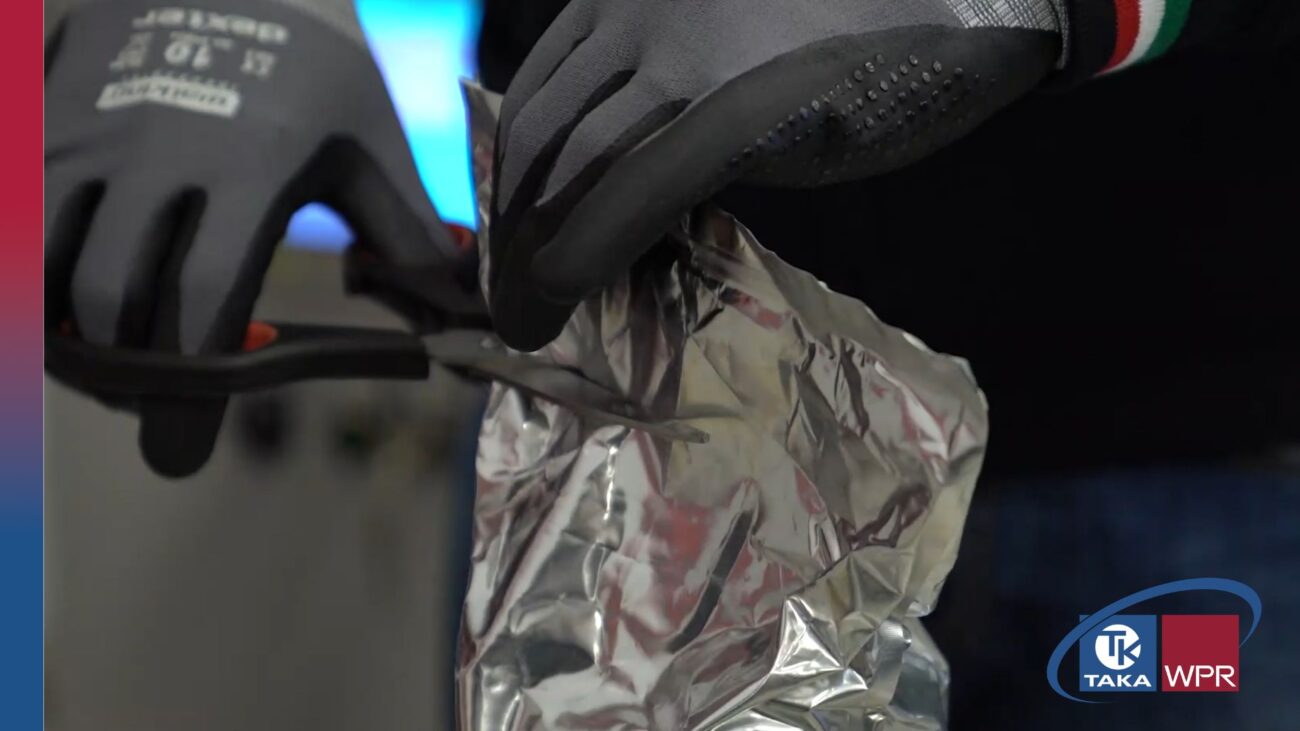
Opening a block of glue and loading it into the melter seems like one of the most basic steps on the production line. Actually, it’s an operation that needs to be done the right way: an opening carried out badly can expose the glue to the air prematurely, with consequences that only show up later.
So how should you open a 20 kg block of glue?
Checking the packaging
In the case of a 20 kg block of HMPUR glue, the packaging can be considered properly sealed when the aluminium foil is vacuum-packed and shows no holes, tears or other damage.
This check is particularly important because HMPUR glues are moisture-reactive adhesives. During transport and storage, they must therefore be adequately protected from contact with atmospheric moisture, generally through vacuum packaging or packaging filled with an inert gas, such as nitrogen.
If the packaging is damaged or no longer provides insulation from moisture, the glue can begin to crosslink while still inside the pack. In this case, the material may reach the process partially reacted, with negative consequences for its characteristics and for subsequent processing (e.g. the glue not melting properly).
For this reason, a visual check of the packaging’s integrity should be carried out before opening every block. If the foil is no longer vacuum-sealed, or is punctured or damaged, it’s best not to use the product.
Cutting it correctly
The block shouldn’t be opened just anywhere. It should be cut horizontally, along the welded/sealed strip: this is the point designed specifically to be opened, and following it ensures clean access to the glue.
From opening to melter: there’s no time to lose
Once you’ve peeled back the foil, the next step needs to be done straight away: the block should be loaded into the melter immediately.
Every minute of delay is time in which the glue stays exposed to the air, and with the air comes moisture.
For a polyurethane glue, this means one concrete risk: the onset of unwanted cross-linking, before the material has even been applied where it’s needed. A glue that has already begun to react is a glue that, in production, will no longer behave as expected.
Upside down or the right way up?
There’s a second detail that’s easy to underestimate: the way round the block is positioned in the melter.
It should be inserted vertically, with the top facing upwards — that is, keeping the same orientation it originally had.
In summary
Four precautions, a single objective: preserving the integrity of the glue from the moment it’s opened right through to when it enters production.
- Check the packaging.
- Cut the block horizontally, along the welded strip.
- Load it into the melter immediately after opening, to limit exposure to the air.
- Position it vertically, keeping the original orientation.
An action that takes just a few seconds, but that makes the difference between a glue that melts evenly and one that starts out already compromised.
If you’d like to find out more, get in touch with our technical team filling the form below