
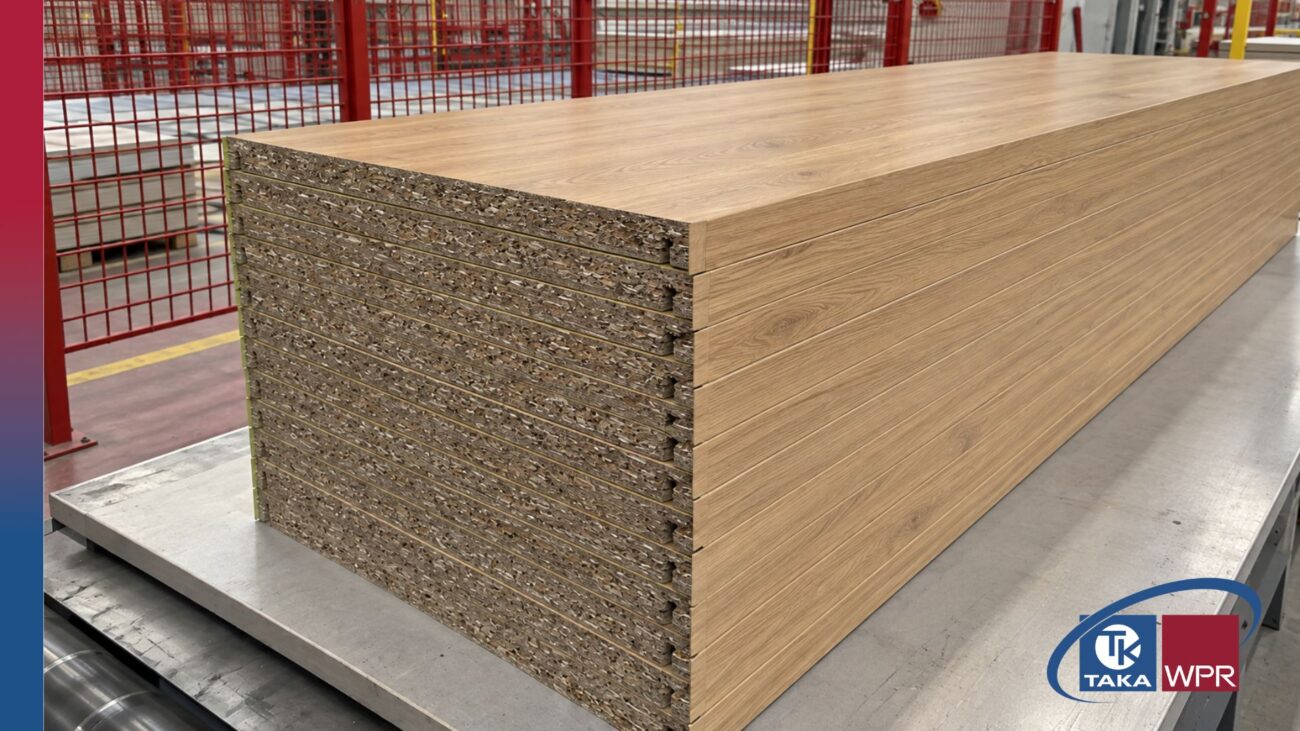
Anyone who laminates panels every day knows it: the storage stage isn’t a minor detail but it’s part of the production process just as much as the bonding itself. Putting panels away in the wrong conditions can compromise hours of work and, in the worst cases, ruin the decorative finish.
The starting point: cross-linking of the glue
Immediately after bonding, HMPUR adhesive hasn’t yet completed its cross-linking process. Over time, the chemical reaction progressively brings the adhesive to develop its final properties of thermal and chemical resistance, along with resistance to water.
Cross-linking typically takes place after the wrapping process, during the storage of the finished product. The moisture present in the environment and in the substrates involved in the process allows the reaction to continue, gradually transforming the adhesive from an initial state into a cross-linked polyurethane structure.
There’s no recommended period for handling the panels that holds true for every glue; in fact, this period falls within a range that can be checked in the technical data sheet of the adhesive used.
The right period depends on three main factors:
- the type of glue and its chemical formulation;
- the temperature of the storage environment;
- the humidity present in the warehouse.
Why temperature and season make the difference
Cross-linking almost always takes place inside the warehouse, but the warehouse itself isn’t a constant environment: it changes with the seasons.
The same glue that cross-links in a certain time during the summer behaves differently in winter, when lower temperatures or lower humidity levels can slow down the chemical reaction.
For this reason, the same waiting parameters can’t be applied mechanically all year round: they need to be adapted to the real conditions of the warehouse, season by season.
A step often underestimated: cleaning before storage
There’s one last check, simple but decisive, to carry out before putting the laminated panels into storage: making sure they’re clean.
Residue and impurities left on the surface during stacking can mark the decorative foil, damaging the finish in a way that’s often irreversible.
A well-processed panel can therefore come out of the warehouse compromised simply because of a missed check at this stage.
In summary
Storing wrapped panels correctly means holding three variables together — type of glue, ambient temperature/humidity, surface cleanliness — and not treating them as a single fixed rule.
Respecting the correct cross-linking times for each season and each formulation, and always checking cleanliness before stacking, is the difference between a panel that keeps the quality of its finish and one that loses it at the very last step of the process.
Every production line, however, has its own specific variables — type of substrate, warehouse layout, local climatic conditions — that a general guide can’t fully cover.
For those wanting to calibrate these parameters to their own process, the Academy offers tailored consultancy programmes, designed to translate the real conditions of each plant into precise operational guidance. Get in touch.